Espionage and intelligence work
An Officer and a SpyEspionage and intelligence work is presented as the concealed operational life of the French General Staff: a discipline built from agents, surveillance, fragments of documents, and reports whose uncertain contents can nevertheless move troops or shape the fate of a case. For Georges Picquart, command of the Statistical Section begins as a promotion he accepts out of military duty, despite his distaste for spying. It becomes the vantage point from which he discovers the practices that produced the case against Alfred Dreyfus—and the machinery by which superiors try to contain what that discovery means.
Appointment and the hidden institution
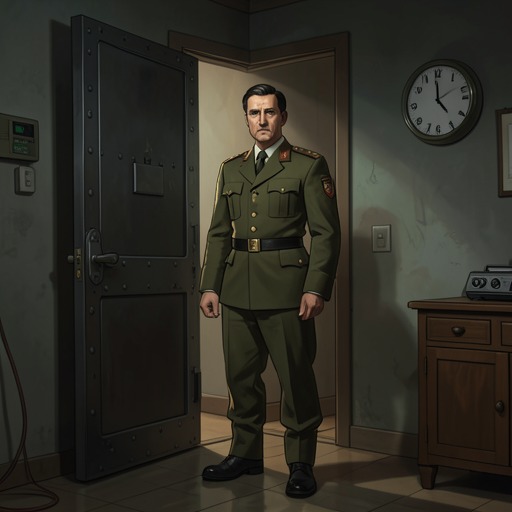
Charles-Arthur Gonse presents Picquart with command of the Statistical Section as recognition of his conduct during the Dreyfus affair and of the intelligence experience he has gained over the preceding three months. The Minister and Chief of Staff, Gonse says, have been impressed; the appointment would bring Picquart promotion to colonel and daily access to the minister. Picquart objects that he knows nothing about spying and points out that Jean Sandherr already commands the section. Gonse answers that Sandherr is seriously ill and has held the post for ten years. Picquart accepts because the Army has asked him to serve, not because intelligence work accords with his idea of soldiering.
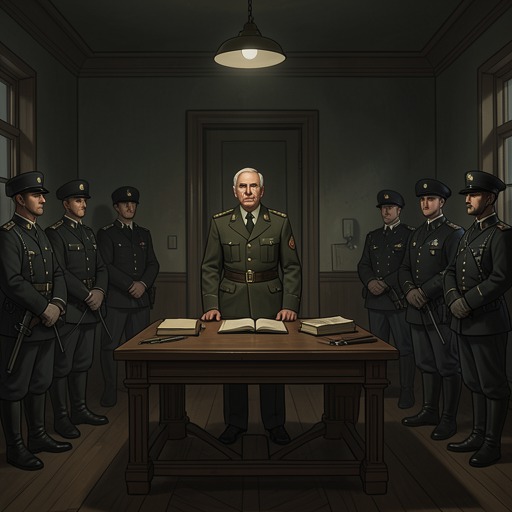
The post is institutionally peculiar. Gonse explains that the section does not officially exist: there will be no parades and no newspaper accounts, and Picquart will not be able to tell anyone what he does. Yet those who matter will know. The secrecy is more than a rule governing individual reports; it defines the unit’s place inside the Ministry of War (France). Picquart likens its private practices to the rites of a religious sect. Officers of the French General Staff on the rue Saint-Dominique are nicknamed the Dominicians, but, in his view, even their secretive habits do not match those of the Statistical Section. The contrast makes intelligence work appear at once essential to the Army and hidden from ordinary institutional life.
Sources, routines, and uncertain reports
The section’s information begins with an agent inside the German Embassy in Paris. The agent passes on papers discarded for destruction in the embassy furnace. Many arrive torn into pieces, so Captain Lauth reconstructs them; the work is skilled, painstaking, and treated as a route by which the section first came upon Dreyfus. The account therefore locates intelligence not in a single revelation but in a chain: material is discarded, secretly recovered, pieced together, and interpreted by officers who must decide what it signifies.
A separate channel involves Guénée of the Sûreté, whom Major Henry brings to brief Picquart. Guénée has been running surveillance on the Dreyfus family. His report and the files brought by both men show that intelligence gathering reaches beyond foreign diplomatic papers into the observation of people connected with the case. Different sources and methods converge inside the section, but their accumulation does not itself guarantee sound conclusions.
Picquart’s first confidential report, known as a blanc, is assembled from local German newspapers and an agent’s letter interpreted by Sandherr. It relays a correspondent’s account of increased activity among troops in the Metz garrison. Picquart cannot tell whether the information is important or even true, but he is expected to submit a report at least once a week. Boisdeffre acknowledges it, forwards a copy to the head of the infantry, and the report contributes to several days of extra drills and forced marches for fifty thousand troops on the eastern frontier. The episode gives secret intelligence a concrete consequence before its reliability has been established. Picquart’s lesson is that the designation itself can command attention: information treated as secret may prompt otherwise rational men to act as though its significance were beyond question.
Covert collection and control of evidence
The collection from Agent Auguste makes the section’s secrecy physical and procedural. When she has material to deliver, she signals by placing a particular flowerpot on the balcony of her apartment on the rue Surcouf. The signal means that she will be at the Basilica of Sainte-Clotilde at nine that evening. In October, Picquart asks to make the collection himself, partly to understand how the process works. In civilian clothes, carrying a briefcase, he follows Henry’s instructions: in a deserted side chapel, he finds a prayer book placed on a particular chair and inserts two hundred francs between its pages. He then withdraws to wait. A religious setting becomes a discreet meeting point, while an ordinary-looking visit conceals an exchange between agent and officer.
The flow of material also produces disputes over custody and authority. Picquart learns that Henry has worked on a batch from Agent Auguste at home, and objects that sensitive material should come straight to the office as soon as it is collected. Henry assures him that it never left his sight, but Picquart says that is not the point: he wants future deliveries to go directly to him, kept in his safe, so that he can decide which leads are followed and who handles them. Henry later shows him the reconstruction already completed and offers to teach him the technique. Picquart finds the work too fiddly and time-consuming to take over; his compromise is to make the preliminary examination while leaving the reconstruction to Henry and Lauth. The arrangement restores outward peace, though Picquart occasionally sees Henry, Lauth, and Junck talking quietly and dispersing quickly when he approaches. He hears Henry complain that Picquart thinks himself cleverer than everyone else, but cannot be certain the remark is about him.
Intelligence against institutional truth
When Picquart presents his investigation of Ferdinand Walsin Esterhazy to Gonse, he lays out the petit bleu, surveillance photographs, and the secret file. Gonse examines the papers methodically, but Picquart’s conclusion is that the file contains nothing capable of establishing Dreyfus’s guilt beyond doubt or of surviving even brief cross-examination. Gonse’s response draws a boundary around what the intelligence is allowed to establish: Picquart may investigate Esterhazy, but is told to forget the bordereau and not connect that investigation to it. The instruction does not end the inquiry; it seeks to separate a new suspect from the evidence that could unsettle Dreyfus’s conviction.
As press attention grows, Gonse acknowledges that the original investigation was not conducted as professionally as it should have been. He invokes Sandherr’s illness, the handling of the case, the wounds another review would reopen, and the danger of public hysteria tearing the country apart. His appeal presents silence as a way to avoid further disorder. Picquart is briefly moved by Gonse’s entreaty, but the Chief of Intelligence ultimately turns to the command structure: the Minister gives orders to the Chief of Staff, the Chief of Staff to Gonse, and Gonse to Picquart. He formally orders Picquart to stop investigating anything connected with Dreyfus and not to disclose information to anyone unauthorized to receive it. Intelligence secrecy, initially a condition of gathering information, has become an instrument for restricting what may be done with it.
That restriction is reinforced through administrative control of the sources. When Picquart hands over the file marked D, he asks whether everything is there. Gonse replies that it had better be, then announces that, during Picquart’s impending tour of inspection, Major Henry will bring all Agent Auguste’s material directly to him. Picquart protests that Auguste is the section’s most important source. Gonse answers that the material belongs with him as head of the intelligence department. The episode completes the account’s double movement: secret channels make investigation possible, but whoever controls access to their documents and agents can also redirect, narrow, or obstruct it. Intelligence work is thus shown not simply as the collection of facts, but as a contest over custody, interpretation, and the authority to act on what is known.